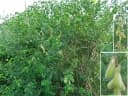
Crotalaria incana
Crotalaria incana
Safety & Hazards
The plant contains toxins, including pyrrolizidine alkaloids. Cattle avoid eating it[ 310 Title Plant Resources of Southeast Asia Publication Author Website http://proseanet.org/ Publisher Year 0 ISBN Description Lots of information on the uses of the plants of SE Asia. ]. Many members of this genus are known to contain pyrrolizidine alkaloids, the most potent of which in this genus are monocrotaline, retrorsine and retronecine[ 1309 Title The Leguminosae; A Source Book of Characteristics, Uses and Nodulation Publication Author Allen O.N.; Allen E.K. Publisher University of Wisconsin Year 1981 ISBN 0-333-32221-5 Description An amazing and comprehensive work, giving a brief guide to the many genera of the family Fabaceae and also the principle uses of the genus. ]. These alkaloids have a cumulative effect upon the body and, unless concentrations in a plant are high, occasional consumption is generally completely safe. Pyrrolizidine alkaloids are derived from amino acids including ornithine. Many of these alkaloids have pronounced hepatic toxicity, but the lungs and other organs may be affected as well. Mutagenic and carcinogenic activities of pyrrolizidine alkaloids have also been reported[ 299 Title Protabase - Plant Resources of Tropical Africa. Publication Author Website http://www.prota.org Publisher Year 0 ISBN Description An excellent on-line database with detailed information on over 3,200 species of useful plants of Africa. ].
Botanical Description
Crotalaria incana varies from an erect annual to a somewhat woody perennial plant. It commonly grows from 25 - 130cm tall, exceptionally to 350cm, usually with spreading branches[ 305 Title Pacific Island Ecosystems at Risk Publication Author Website http://www.hear.org/pier/scientificnames/index.html Publisher Year 0 ISBN Description A very good website detailing weed species that have been introduced into the Pacific Islands. , 310 Title Plant Resources of Southeast Asia Publication Author Website http://proseanet.org/ Publisher Year 0 ISBN Description Lots of information on the uses of the plants of SE Asia. ]. The plant is sometimes harvested from the wild for local use as a medicine. It has shown promise as a green manure crop in coffee.