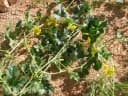
Cucumis africanus
Cucumis africanus
Safety & Hazards
The fruits, especially the bitter forms, contain considerable amounts of cucurbitacin A, B and D and traces of cucurbitacin G and H. Cucurbitacins, which are known from many Cucurbitaceae and various other plant species, have been shown to exhibit cytotoxicity (including antitumor activity), anti-inflammatory and analgesic activities[ 299 Title Protabase - Plant Resources of Tropical Africa. Publication Author Website http://www.prota.org Publisher Year 0 ISBN Description An excellent on-line database with detailed information on over 3,200 species of useful plants of Africa. ].
Botanical Description
Cucumis africanus is an annual or perhaps sometimes a perennial herb, or at least sometimes developing a woody rootstock. The stems are up to 2 metres long, either scrambling over the ground or climbing into other plants, where they support themselves by means of tendrils[ 295 Title PlantZAfrica.com Publication Author Website http://www.plantzafrica.com Publisher Year 0 ISBN Description An excellent site giving detailed descriptions and uses of many S. African plants. , 299 Title Protabase - Plant Resources of Tropical Africa. Publication Author Website http://www.prota.org Publisher Year 0 ISBN Description An excellent on-line database with detailed information on over 3,200 species of useful plants of Africa. , 308 Title Flora Zambesiaca Publication Author Website http://apps.kew.org/efloras/fz/intro.html Publisher Year 0 ISBN Description An excellent online flora of plants from the Zambezi River basin. It lists a number of the plant uses as well as the habitats and botanical descriptions of the plants. ]. The plant is harvested from the wild as a local source of food and medicine.