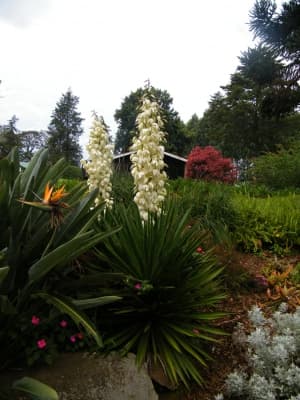
Yucca gloriosa
Yucca gloriosa
Safety & Hazards
The roots contain saponins[ 222 Title A Field Guide to Medicinal Plants. Eastern and Central N. America. Publication Author Foster. S. & Duke. J. A. Publisher Houghton Mifflin Co. Year 1990 ISBN 0395467225 Description A concise book dealing with almost 500 species. A line drawing of each plant is included plus colour photographs of about 100 species. Very good as a field guide, it only gives brief details about the plants medicinal properties. ]. Although poisonous, saponins also have a range of medicinal applications and many saponin-rich plants are used in herbalism (particularly as emetics, expectorants and febrifuges) or as sources of raw materials for the pharmaceutical industry. Saponins are also found in a number of common foods, such as many beans. Saponins have a quite bitter flavour and are in general poorly absorbed by the human body, so most pass through without harm. They can be removed by carefully leaching in running water. Thorough cooking, and perhaps changing the cooking water once, will also normally remove most of them. However, it is not advisable to eat large quantities of raw foods that contain saponins. Saponins are much more toxic to many cold-blooded creatures, such as fish, and hunting tribes have traditionally put large quantities of them in streams, lakes etc in order to stupefy or kill the fish and make them easy to catch[ K Title Plants for a Future Author Ken Fern Description Notes from observations, tasting etc at Plants For A Future and on field trips. ].
Botanical Description
Yucca gloriosa is an evergreen shrubby plant growing 2.5 metres or more tall. The stems can be unbranched or, more commonly, branched, each plant eventually producing a clump of stems[ 270 Title Flora of N. America Publication Author Website http://flora.huh.harvard.edu/fna/ Publisher Year 0 ISBN Description An on-line version of the flora with an excellent description of the plant including a brief mention of plant uses. ]. The plant is cultivated as a fibre crop and medicinal plant in Central America, S France (Mediterranean coast), Algeria, India and on the eastern coast of the Black Sea. It is planted as a living fence in Cuba and is also frequently cultivated as an ornamental in the tropics, subtropics and the warm-temperate zone[ 317 Title Mansfeld's Database of Agricultural and Horticultural Plants Publication Author Website http://mansfeld.ipk-gatersleben.de/pls/htmldb_pgrc/f?p=185:3:4292127278597336 Publisher Year 0 ISBN Description Terse details of a huge range of useful plants. ]. Yucca gloriosa has a wide range and is locally abundant. Even though its habitat and population are experiencing some decline, currently this does not occur at a rate to trigger a threat category. The plant is classified as 'Least Concern' in the IUCN Red List of Threatened Species(2020)[ 338 Title IUCN Red List of Threatened Species Publication Author Website http://www.iucnredlist.org/ Publisher Year 0 ISBN Description A list of plants under threat and facing possible extinction, usually with brief details of the threats and information on habitat. ].