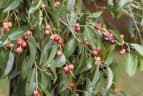
Ficus benjamina
Ficus benjamina
Safety & Hazards
The sap from the plant contains furocoumarins, psoralens and ficin[ 293 Title Poisonous Plants of North Carolina Publication Author Website http://www.ces.ncsu.edu/depts/hort/consumer/poison/poison.htm Publisher Year 0 ISBN Description An excellent concise but comprehensive guide to toxic plants that grow in N. Carolina. It lists even those plants that are of very low toxicity, including several well-known food plants such as carrots and potatoes. ]. Frequent contact can cause iching of the eyes, cough, and wheezing; contact and exposure to sunlight can cause skin irritation with itching, redness and stinging. Effects are usually minor or only lasting for a few minutes[ 293 Title Poisonous Plants of North Carolina Publication Author Website http://www.ces.ncsu.edu/depts/hort/consumer/poison/poison.htm Publisher Year 0 ISBN Description An excellent concise but comprehensive guide to toxic plants that grow in N. Carolina. It lists even those plants that are of very low toxicity, including several well-known food plants such as carrots and potatoes. ].
Botanical Description
Ficus benjamina is an evergreen tree with a dense, wide crown; it can grow 15 - 30 metres tall. The bole can be 30 - 60cm in diameter[ 266 Title Flora of China Publication Author Website http://flora.huh.harvard.edu/china/ Publisher Missouri Botanical Garden Press; St. Louis. Year 1994 ISBN Description An excellent, comprehensive resource in 25 volumes. In addition to the botanical information the flora also gives basic information on habitat and some uses. An on-line version is also available. , 653 Title Plants of Southeast Asia Publication Author Website http://www.asianplant.net/ Publisher Year 0 ISBN Description Excellent site with brief information on the plant, its range, habitat and uses, plus phots of specimens, close-ops of flowers and leaves etc, ]. The plant usually begins life as an epiphyte, growing in the branch of another tree; as it grows older it sends down aerial roots which, when they reach the ground quickly form roots and become much thicker and more vigorous. They supply nutrients to the fig, allowing it to grow faster than the host tree. The aerial roots gradually encircle the host tree, preventing its main trunk from expanding, whilst at the same time the foliage smothers the foliage of the host. Eventually the host dies, leaving the fig to carry on growing without competition. The tree is harvested from the wild for local use as a medicine and source of fibre plus a low quality wood. It is very ornamental, being widely cultivated in the tropics and subtropics and used as an avenue and shade-providing tree[ 345 Title Minor Products of Philippine Forests Publication Author Brown. W. H. Publisher Bureau of Forestry, Manilla. Year 1920 ISBN Description A useful guide to some of the plants of the area, though terse on details. The book is out of copyright and can be legally downloaded from the Internet. ]. It has long been an extremely popular indoor houseplant because of its attractive shape and tolerance for a variety of growing conditions, usually growing 60 - 300cm tall in the pot[ 352 Title KemperCentreForHomeGardeningPlantFinder Publication Author Website http://www.mobot.org/gardeninghelp/plantfinder/ Publisher Missouri Botanical Garden Year 0 ISBN Description Basic cultivation details, plant uses, habitat etc for several thousand species of plants, mainly from the temperate zone. ]. The plant is grown as a pioneer species in reforestation projects in Thailand[ 998 Title Forest Restoration Planting in Northern Thailand Publication Proceedings of the Southeast Asian Moving Workshop on Conservation, Management and Utilization of Forest Genetic Resources No. 31/2002 Author Pakkad G.; Elliott S.; Anusarnsunthorn V. Et al Website http://www.fao.org/ Publisher Food and Agriculture Organization of the United Nations; Bangkok Year 2002 ISBN Description A report on reforestation in northern Thailand by using specific pioneer species. It can be downloaded from the Internet. ].