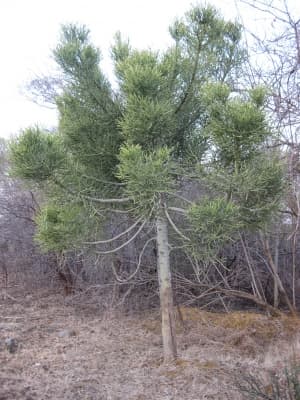
Euphorbia tirucalli
Euphorbia tirucalli
Safety & Hazards
The caustic, irritant sap contains a latex and is highly poisonous, causing severe injury to the eye, irritation and vesication from contact, emesis and purgation from ingestion[ 299 Title Protabase - Plant Resources of Tropical Africa. Publication Author Website http://www.prota.org Publisher Year 0 ISBN Description An excellent on-line database with detailed information on over 3,200 species of useful plants of Africa. , 303 Title World Agroforesty Centre Publication Author Website http://www.worldagroforestry.org/ Publisher Year 0 ISBN Description An excellent online database of a huge range of trees giving very good information on each plant - its uses, ecology, identity, propagation, pests etc. ]. Eye contact with the sap can cause blindness lasting several days[ 332 Title The Useful Plants of West Tropical Africa. Publication Author Burkil. H. M. Publisher Royal Botanic Gardens; Kew. Year 1985 - 2004 ISBN Description Brief descriptions and details of the uses of over 4,000 plants. A superb, if terse, resource, it is also available electronically on the Web - see http://www.aluka.org/ ]. The toxicity of the latex is considered seasonal or reduced in young plant parts, and young branches are even roasted and chewed[ 299 Title Protabase - Plant Resources of Tropical Africa. Publication Author Website http://www.prota.org Publisher Year 0 ISBN Description An excellent on-line database with detailed information on over 3,200 species of useful plants of Africa. ]. The extracts of the plant contain a number of esters of the tetracyclic diterpenoid phorbol, many of which have been shown to act as tumour promoters (cocarcinogens). Their co-carcinogenic effect on lymphoblastoid cells poses a real threat in Africa where drinking water is drawn around the plants[ 303 Title World Agroforesty Centre Publication Author Website http://www.worldagroforestry.org/ Publisher Year 0 ISBN Description An excellent online database of a huge range of trees giving very good information on each plant - its uses, ecology, identity, propagation, pests etc. ]. In East Africa the latex is commonly used as arrow poison and as an ingredient for bait to kill rodents and other wild animals; the pulped stems are thrown in water as fish poison[ 299 Title Protabase - Plant Resources of Tropical Africa. Publication Author Website http://www.prota.org Publisher Year 0 ISBN Description An excellent on-line database with detailed information on over 3,200 species of useful plants of Africa. ]. In south-western DR Congo the latex has been used in high doses as a trial by ordeal poison; in various countries it is used as criminal poison[ 299 Title Protabase - Plant Resources of Tropical Africa. Publication Author Website http://www.prota.org Publisher Year 0 ISBN Description An excellent on-line database with detailed information on over 3,200 species of useful plants of Africa. ].
Botanical Description
Euphorbia tirucalli is an unarmed, succulent shrub or small tree usually growing from 4 - 12 metres tall with some specimens up to 15 metres[ 303 Title World Agroforesty Centre Publication Author Website http://www.worldagroforestry.org/ Publisher Year 0 ISBN Description An excellent online database of a huge range of trees giving very good information on each plant - its uses, ecology, identity, propagation, pests etc. ]. It has brittle, succulent branchlets around 7mm thick, with white to yellowish latex[ 303 Title World Agroforesty Centre Publication Author Website http://www.worldagroforestry.org/ Publisher Year 0 ISBN Description An excellent online database of a huge range of trees giving very good information on each plant - its uses, ecology, identity, propagation, pests etc. ]. The plant only has a few, small, deciduous leaves towards the tips of the branches, photosynthesis being carried out mainly by the green stems[ 302 Title Tropical Ornamentals; A Guide Publication Author Whistler. W. Arthur. Publisher Timber Press Inc. Oregon. Year 2000 ISBN 0-88192-448-2 Description An excellent little guide to some of the more commonly cultivated ornamental plants of the Tropics, often giving some information on the plants other uses. , 360 Title Philippine Medicinal Plants Publication Author Website http://www.stuartxchange.org/CompleteList.html Publisher Year 0 ISBN Description A lovely site, giving brief details on the medicinal uses of several hundred (over 400 at the last count) plants in the Philippines, plus a picture of each plant. ]. Although poisonous, the plant is commonly harvested from the wild for a wide range of medicinal uses, and also provides several other commodities. It is widely planted for use as a hedge and has long been used in agroforestry systems in east Africa. This is a low-input plant that has high drought and salinity stress tolerance and can be grown on land that is not generally suitable for crops. It has the potential to provide semi-arid zone inhabitants with an energy solution in the form of a biomass that can be converted to gaseous, liquid or solid biofuels[ 299 Title Protabase - Plant Resources of Tropical Africa. Publication Author Website http://www.prota.org Publisher Year 0 ISBN Description An excellent on-line database with detailed information on over 3,200 species of useful plants of Africa. ]. This is an ideal species for agroforestry, offering little shade and having many other uses[ 303 Title World Agroforesty Centre Publication Author Website http://www.worldagroforestry.org/ Publisher Year 0 ISBN Description An excellent online database of a huge range of trees giving very good information on each plant - its uses, ecology, identity, propagation, pests etc. ]. It is also widely planted for ornamental purposes[ 303 Title World Agroforesty Centre Publication Author Website http://www.worldagroforestry.org/ Publisher Year 0 ISBN Description An excellent online database of a huge range of trees giving very good information on each plant - its uses, ecology, identity, propagation, pests etc. ]. The species is present in all the tropical parts of the world and is common throughout its range. The plant is classified as 'Least Concern' in the IUCN Red List of Threatened Species(2013)[ 338 Title IUCN Red List of Threatened Species Publication Author Website http://www.iucnredlist.org/ Publisher Year 0 ISBN Description A list of plants under threat and facing possible extinction, usually with brief details of the threats and information on habitat. ].