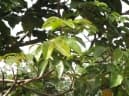
Joannesia princeps
Joannesia princeps
Safety & Hazards
The oil obtained from the seed is strongly purgative and can be toxic[ 372 Title Flowers of India Publication Author Website http://www.flowersofindia.net/ Publisher Year 0 ISBN Description A wed site of native Indian plants, plus cultivated and naturalized species. It has good quality photos and terse details on more than 3,000 species and cultivars. ]. The latex in the bark is toxic[ 348 Title Medicinal Plants of the Guianas Publication Author DeFilipps, R. A.; Maina, S. L.; & Crepin, J. Website http://botany.si.edu/bdg/medicinal/index.html Publisher Smithsonian Museum Year 0 ISBN Description A down-loadable PDF document of a book in pre-publication awaiting illustration. An excellent, if rather terse, guide to the traditional medicinal uses of the plants of the region ].
Botanical Description
Joannesia princeps is a deciduous tree with an elongated, dense crown; it can grow 15 - 20 metres tall. The erect bole is 40 - 60cm in diameter[ 419 Title Brazilian Trees. Volume 1. 4th Edition. Publication Author Lorenzi. H. Publisher Instituto Plantarum De Estudos Da Flora; Brazil. Year 2002 ISBN 85-86714-17-8 Description Information on 350 species of Brazilian trees. Stunning photographs of each species, brief details on the plant, its uses and how to grow it from seed. A superb work, with the minor irritation that the translation from Portuguese is not of the best. ]. The plant is cultivated in many tropical countries, especially in Asia but also in Africa, for the oil obtained from its seed, and also for ornamental purposes[ 317 Title Mansfeld's Database of Agricultural and Horticultural Plants Publication Author Website http://mansfeld.ipk-gatersleben.de/pls/htmldb_pgrc/f?p=185:3:4292127278597336 Publisher Year 0 ISBN Description Terse details of a huge range of useful plants. , 372 Title Flowers of India Publication Author Website http://www.flowersofindia.net/ Publisher Year 0 ISBN Description A wed site of native Indian plants, plus cultivated and naturalized species. It has good quality photos and terse details on more than 3,000 species and cultivars. ]. The species has been in decline through forest conversion for agriculture, livestock and plantation projects. In addition, it is exploited for its valuable wood. The plant is classified as 'Vulnerable' in the IUCN Red List of Threatened Species(2011)[ 338 Title IUCN Red List of Threatened Species Publication Author Website http://www.iucnredlist.org/ Publisher Year 0 ISBN Description A list of plants under threat and facing possible extinction, usually with brief details of the threats and information on habitat. ].