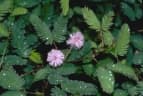
Mimosa pudica
Mimosa pudica
Safety & Hazards
When the prickles on the stem and the fruits become too hard, they can cause intestinal inflammation in grazing animals[ 418 Title Ecocrop Publication Author Website http://ecocrop.fao.org/ecocrop/srv/en/home Publisher Year 0 ISBN Description Basic information on a wide range of useful plants, plus details of environmental needs where available. ]. The roots are toxic in large doses[ 348 Title Medicinal Plants of the Guianas Publication Author DeFilipps, R. A.; Maina, S. L.; & Crepin, J. Website http://botany.si.edu/bdg/medicinal/index.html Publisher Smithsonian Museum Year 0 ISBN Description A down-loadable PDF document of a book in pre-publication awaiting illustration. An excellent, if rather terse, guide to the traditional medicinal uses of the plants of the region ].
Botanical Description
Mimosa pudica is an annual to perennial, more or less prostrate creeping plant[ 418 Title Ecocrop Publication Author Website http://ecocrop.fao.org/ecocrop/srv/en/home Publisher Year 0 ISBN Description Basic information on a wide range of useful plants, plus details of environmental needs where available. ]. The plant can grow up to 1 metre tall, but is more likely to be 15 - 45cm tall, the stems usually becoming woody[ 413 Title Global Invasive Species Database Publication Author Website http://www.issg.org/database/welcome/ Publisher Year 0 ISBN Description Very detailed information on almost 400 species (with more being added) of plants that have become weeds in areas outside their native range. , 646 Title New Crops FactSheets Publication Author Website http://www.hort.purdue.edu/newcrop/default.html Publisher Purdue University Year 0 ISBN Description A website dedicated to giving information on potential new agricultural crops. ]. The plant is gathered from the wild for local medicinal use. It is cultivated as a green manure and for soil stabilization, and is sometimes also cultivated for its uses in folk medicine[ 317 Title Mansfeld's Database of Agricultural and Horticultural Plants Publication Author Website http://mansfeld.ipk-gatersleben.de/pls/htmldb_pgrc/f?p=185:3:4292127278597336 Publisher Year 0 ISBN Description Terse details of a huge range of useful plants. ]. It is commonly grown as an ornamental, being valued especially for the novelty of its leaves drooping downwards whenever touched[ 413 Title Global Invasive Species Database Publication Author Website http://www.issg.org/database/welcome/ Publisher Year 0 ISBN Description Very detailed information on almost 400 species (with more being added) of plants that have become weeds in areas outside their native range. ]. Mimosa pudica is very widespread in Central America, South America and the Caribbean. This taxon is known to occur within a number of protected areas throughout the species range and seeds have been collected and stored by the Millennium Seed Bank Project as a method of ex situ conservation. It is common and not considered to be threatened or in decline. The plant is classified as 'Least Concern' in the IUCN Red List of Threatened Species(2013)[ 338 Title IUCN Red List of Threatened Species Publication Author Website http://www.iucnredlist.org/ Publisher Year 0 ISBN Description A list of plants under threat and facing possible extinction, usually with brief details of the threats and information on habitat. ].