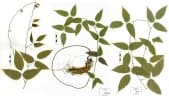
Mucuna gigantea
Mucuna gigantea
Safety & Hazards
Mucuna species often possess irritant hairs on the seedpods and sometimes on the flowers and other parts. These hairs consist of 1-2 small basal cells and a large needle-like top cell. The top cell breaks off easily, piercing the skin and injecting chemical compounds that are present in the hairs. The proteolytic enzyme 'Mucunain' is said to be the active agent[ 1533 Title Notes on Malesian Fabaceae (Leguminosae-Papilionoideae) 16. The genus Mucuna Publication Blumea 61, 2016: 90-124 Author Wiriadinata H.; Ohashi H.; Adema F. Website http://dx.doi.org/10.3767/000651916X692799 Publisher Year 2016 ISBN Description An excellent treatment ]. The hairs can contaminate clothes or other objects, and remain active when dried, though they can be destroyed by heat[ 299 Title Protabase - Plant Resources of Tropical Africa. Publication Author Website http://www.prota.org Publisher Year 0 ISBN Description An excellent on-line database with detailed information on over 3,200 species of useful plants of Africa. , 374 Title Contact-Poisonous Plants of the World Publication Author Rohde. M. Website http://mic-ro.com/plants/ Publisher Year 2006 ISBN Description A document on the internet. Gives brief information on about 35 species of plants that can cause severe problems from a single contact with the skin. , 1309 Title The Leguminosae; A Source Book of Characteristics, Uses and Nodulation Publication Author Allen O.N.; Allen E.K. Publisher University of Wisconsin Year 1981 ISBN 0-333-32221-5 Description An amazing and comprehensive work, giving a brief guide to the many genera of the family Fabaceae and also the principle uses of the genus. ]. Intense itching, with reddening of the skin and small papules or urticaria occur a few minutes after contact with the hairy parts of the plant. There is no serious danger, unless the hairs get into the eye, in which case, in extreme situations, they have caused blindness. To remove the hairs from the skin, adhesive tape and washing with water and soap are considered useful. Dermatitis can be treated with corticosteroid ointment. See a doctor immediately if hairs go into the eyes[ 374 Title Contact-Poisonous Plants of the World Publication Author Rohde. M. Website http://mic-ro.com/plants/ Publisher Year 2006 ISBN Description A document on the internet. Gives brief information on about 35 species of plants that can cause severe problems from a single contact with the skin. ]. These hairs are mentioned as being used in criminal poisoning in Malaysia[ 299 Title Protabase - Plant Resources of Tropical Africa. Publication Author Website http://www.prota.org Publisher Year 0 ISBN Description An excellent on-line database with detailed information on over 3,200 species of useful plants of Africa. ]. Because of the presence of toxic compounds in the plant, it seems advisable to eat the seed only after prolonged soaking and boiling[ 299 Title Protabase - Plant Resources of Tropical Africa. Publication Author Website http://www.prota.org Publisher Year 0 ISBN Description An excellent on-line database with detailed information on over 3,200 species of useful plants of Africa. ].
Botanical Description
Mucuna gigantea is a rampant, woody climbing plant producing stems 8 - 15 metres or more long and up to 10cm in diameter[ 308 Title Flora Zambesiaca Publication Author Website http://apps.kew.org/efloras/fz/intro.html Publisher Year 0 ISBN Description An excellent online flora of plants from the Zambezi River basin. It lists a number of the plant uses as well as the habitats and botanical descriptions of the plants. , 440 Title Brisbane Rainforest Action and Information Network, Publication Author Website http://www.brisrain.webcentral.com.au Publisher Year 0 ISBN Description Information on plants in the Queensland Rainforests. , 713 Title Australian Tropical Rainforest Plants Publication Author Website http://www.anbg.gov.au/cpbr/cd-keys/rfk/index.html Publisher Year 0 ISBN Description An online resource giving botanical information, and a little bit about plant usage, for over 2,700 species of plants found in the Australian rainforest. ]. The plant is sometimes gathered from the wild for its edible seeds and local medicinal uses.