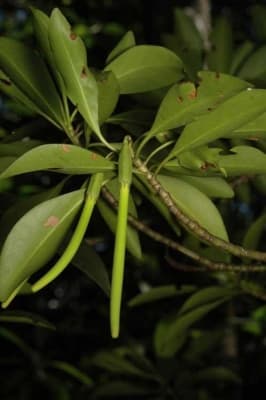
Bruguiera parviflora
Bruguiera parviflora
Safety & Hazards
None known
Botanical Description
Bruguiera parviflora is an evergreen tree growing up to 24 metres tall. The straight bole is 15 - 30cm in diameter, exceptionally to 55cm[ 334 Title Flora of Peninsula Malaysia Publication Author Website http://www.tfbc.frim.gov.my Publisher Year 0 ISBN Description In the process of being assembled (15/07/09), it is currently a series of check sheets giving species name, brief description, habitat and high quality photos of the plants. , 338 Title IUCN Red List of Threatened Species Publication Author Website http://www.iucnredlist.org/ Publisher Year 0 ISBN Description A list of plants under threat and facing possible extinction, usually with brief details of the threats and information on habitat. , 451 Title Flora Malesiana Series 1 Publication Author Various Website http://www.archive.org Publisher Nationaal Herbarium Nederiand, Universiteit Leiden branch Year 0 ISBN Description A massive treatment of the plants of the Malaysian Archipelago. Much of it has been made available to download from the Internet ]. The edible seeds are gathered from the wild for local use[ 46 Title Dictionary of Economic Plants. Publication Author Uphof. J. C. Th. Publisher Weinheim Year 1959 ISBN - Description An excellent and very comprehensive guide but it only gives very short descriptions of the uses without any details of how to utilize the plants. Not for the casual reader. ]. The plant has potential for timber use because of its straight bole[ 338 Title IUCN Red List of Threatened Species Publication Author Website http://www.iucnredlist.org/ Publisher Year 0 ISBN Description A list of plants under threat and facing possible extinction, usually with brief details of the threats and information on habitat. ]. This species is widespread and common throughout its range, except at the extremities of its range such as in India where it is considered rare and locally endangered. It is threatened by the loss of mangrove habitat throughout its range, primarily due to extraction and coastal development, and there has been an estimated 21% decline in mangrove area within this species range since 1980. Mangrove species are more at risk from coastal development and extraction at the extremes of their distribution, and are likely to be contracting in these areas more than in other areas. It is also likely that changes in climate due to global warming will further affect these parts of the range. Although there are overall range declines in many areas, they are not enough to reach any of the threatened category thresholds. This species, therefore, is listed as Least ConcernThe plant is classified as 'Least Concern' in the IUCN Red List of Threatened Species(2013)[ 338 Title IUCN Red List of Threatened Species Publication Author Website http://www.iucnredlist.org/ Publisher Year 0 ISBN Description A list of plants under threat and facing possible extinction, usually with brief details of the threats and information on habitat. ].