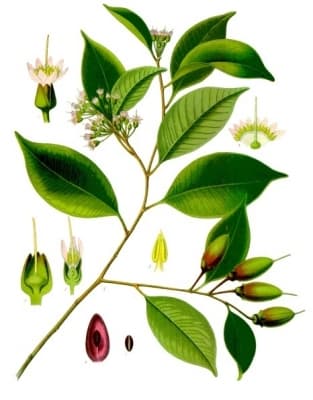
Payena leerii
Payena leerii
Safety & Hazards
None known
Botanical Description
Payena leerii is a tree growing up to 40 metres tall. The bole can be around 80cm in diameter with low, spreading buttresses[ 334 Title Flora of Peninsula Malaysia Publication Author Website http://www.tfbc.frim.gov.my Publisher Year 0 ISBN Description In the process of being assembled (15/07/09), it is currently a series of check sheets giving species name, brief description, habitat and high quality photos of the plants. , 338 Title IUCN Red List of Threatened Species Publication Author Website http://www.iucnredlist.org/ Publisher Year 0 ISBN Description A list of plants under threat and facing possible extinction, usually with brief details of the threats and information on habitat. , 899 Title Tree Flora of Sabah and Sarawak Vols 1 - 6 Publication Author Soepadmo E.; Saw L.G.; Chung R.C.K. (Editors) Publisher Forest Research Institute Malaysia; Kuala Lumpur. Year 2002 ISBN 983-2181-27-5 Description A flora of the woody plants of Sabah and Sarawak on the island of Borneo, often giving details of plant uses. ]. The plant is the source of a good quality gutta-percha and timber, and is also harvested from the wild for local use as a food. It is cultivated on a very small scale in the Philippines for the gutta-percha[ 317 Title Mansfeld's Database of Agricultural and Horticultural Plants Publication Author Website http://mansfeld.ipk-gatersleben.de/pls/htmldb_pgrc/f?p=185:3:4292127278597336 Publisher Year 0 ISBN Description Terse details of a huge range of useful plants. ]. The wood is traded uner the name 'Bitis'[ 338 Title IUCN Red List of Threatened Species Publication Author Website http://www.iucnredlist.org/ Publisher Year 0 ISBN Description A list of plants under threat and facing possible extinction, usually with brief details of the threats and information on habitat. ] Payena leerii has a large range and is known from protected areas. There is, however, a projected continuing decline in the quality of habitat, causing a suspected population decline. Almost 18% of the tree cover in its range has been lost within the period of 2000 - 2017; most collections of the species have been made at low elevations which gives a higher level of risk; and the species is known to be used both as timber and for gutta percha. The tree cover loss and population decline would most likely be much greater if calculated over three generation lengths (60-150 years) and are likely close to the limit for Vulnerable. The plant is classified as 'Near Threatened' in the IUCN Red List of Threatened Species(2013)[ 338 Title IUCN Red List of Threatened Species Publication Author Website http://www.iucnredlist.org/ Publisher Year 0 ISBN Description A list of plants under threat and facing possible extinction, usually with brief details of the threats and information on habitat. ].