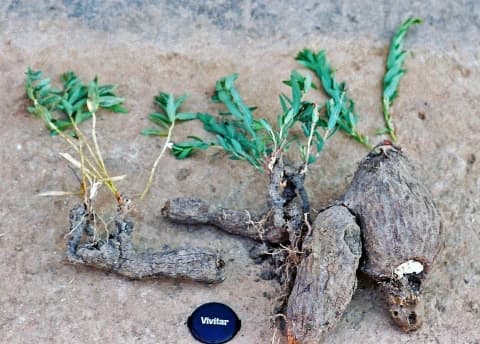
Maerua edulis
Maerua edulis
Safety & Hazards
The plant is known to be toxic[ 387 Title Economic Products of India. Volume 1. Publication Author Watt. G. Publisher Government of India: Calcutta. Year 1883 ISBN Description Although over 100 years old, it still contains a wealth of information on useful plants. Many of the botanical names have been changed since then, so you have to check for up to date names. The book can be downloaded from the Internet. ]. The leaves are used as a fish poison[ 398 Title Edible Wild Plants of Tanzania Publication Author Ruffo, C.K.: Birnie, A. & Tengnas, B. Publisher Regional Land Management Unit; Nairobi. Year 2002 ISBN 9966-896-60-0 Description A very well presented, simple guide to growing and utilizing wild food plants in Tanzania, with line drawings of each plant, a description, habitat and range, non-food as well as food uses, plus basic information on growing the plants. ].
Botanical Description
Maerua edulis is a much-branched, evergreen, perennial plant, with a woody rootstock that is often large and swollen, growing 1 - 3 metres tall. It varies in habit from a herbaceous plant with more or less woody stems , to a true shrub with stiff branches[ 328 Title African Flowering Plants Database Publication Author Website http://www.ville-ge.ch/musinfo/bd/cjb/africa/recherche.php Publisher Conservatoire et Jardin Botaniques. Year 0 ISBN Description Contains information on over 150,000 plant names (including synonyms) giving a description and habitat, plus a distribution map. , 398 Title Edible Wild Plants of Tanzania Publication Author Ruffo, C.K.: Birnie, A. & Tengnas, B. Publisher Regional Land Management Unit; Nairobi. Year 2002 ISBN 9966-896-60-0 Description A very well presented, simple guide to growing and utilizing wild food plants in Tanzania, with line drawings of each plant, a description, habitat and range, non-food as well as food uses, plus basic information on growing the plants. ]. The plant is sometimes harvested from the wild for local use as a food, medicine and means of purifying water. It is sometimes grown as a hedge and ornamental[ 398 Title Edible Wild Plants of Tanzania Publication Author Ruffo, C.K.: Birnie, A. & Tengnas, B. Publisher Regional Land Management Unit; Nairobi. Year 2002 ISBN 9966-896-60-0 Description A very well presented, simple guide to growing and utilizing wild food plants in Tanzania, with line drawings of each plant, a description, habitat and range, non-food as well as food uses, plus basic information on growing the plants. ].