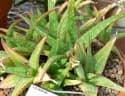
Aloe sinkatana
Aloe sinkatana
Safety & Hazards
The sap of Aloe species contains anthraquinones. These compounds have several beneficial medicinal actions, particularly as a laxative, and many species of Aloe are thus employed in traditional medicine. Whilst safe in small doses and for short periods of time, anthraquinones do have potential problems if used in excess. These include congestion and irritation of the pelvic organs[ 299 Title Protabase - Plant Resources of Tropical Africa. Publication Author Website http://www.prota.org Publisher Year 0 ISBN Description An excellent on-line database with detailed information on over 3,200 species of useful plants of Africa. ]. Long term use of anthraquinone laxatives may also play a role in development of colorectal cancer as they have genotoxic potential, and tumorigenic potential[ 299 Title Protabase - Plant Resources of Tropical Africa. Publication Author Website http://www.prota.org Publisher Year 0 ISBN Description An excellent on-line database with detailed information on over 3,200 species of useful plants of Africa. ].
Botanical Description
Aloe sinkatana is a stemless, evergreen, succulent, perennial plant producing a dense rosette of 16 - 20 leaves. The plant usually produces suckers to form clumps of growth[ 328 Title African Flowering Plants Database Publication Author Website http://www.ville-ge.ch/musinfo/bd/cjb/africa/recherche.php Publisher Conservatoire et Jardin Botaniques. Year 0 ISBN Description Contains information on over 150,000 plant names (including synonyms) giving a description and habitat, plus a distribution map. ]. It is valued as an ornamental[ 299 Title Protabase - Plant Resources of Tropical Africa. Publication Author Website http://www.prota.org Publisher Year 0 ISBN Description An excellent on-line database with detailed information on over 3,200 species of useful plants of Africa. ]. Aloe sinkatana has a very small native range, occurring in a very arid region of Sudan where rainfall can be erratic. Given that the species appears to occur along temporary water courses, changes in rainfall pattern and amounts might pose a significant threat to this species. The plant is classified as 'Endangered' in the IUCN Red List of Threatened Species(2013)[ 338 Title IUCN Red List of Threatened Species Publication Author Website http://www.iucnredlist.org/ Publisher Year 0 ISBN Description A list of plants under threat and facing possible extinction, usually with brief details of the threats and information on habitat. ].